Assistant Professor • University of Oklahoma
Libel, Representation,
and Innovation.
Joseph Mansky researches the interconnected histories of literature, law, and politics in early modern England. His first book studied the viral circulation of libels in and around Shakespeare's theater; his second, which is nearing completion, will show how literature shaped the idea of political representation before the advent of modern representative democracy. Most recently, he has begun to think and write about the idea of innovation, ca. 1500–1700.

Books
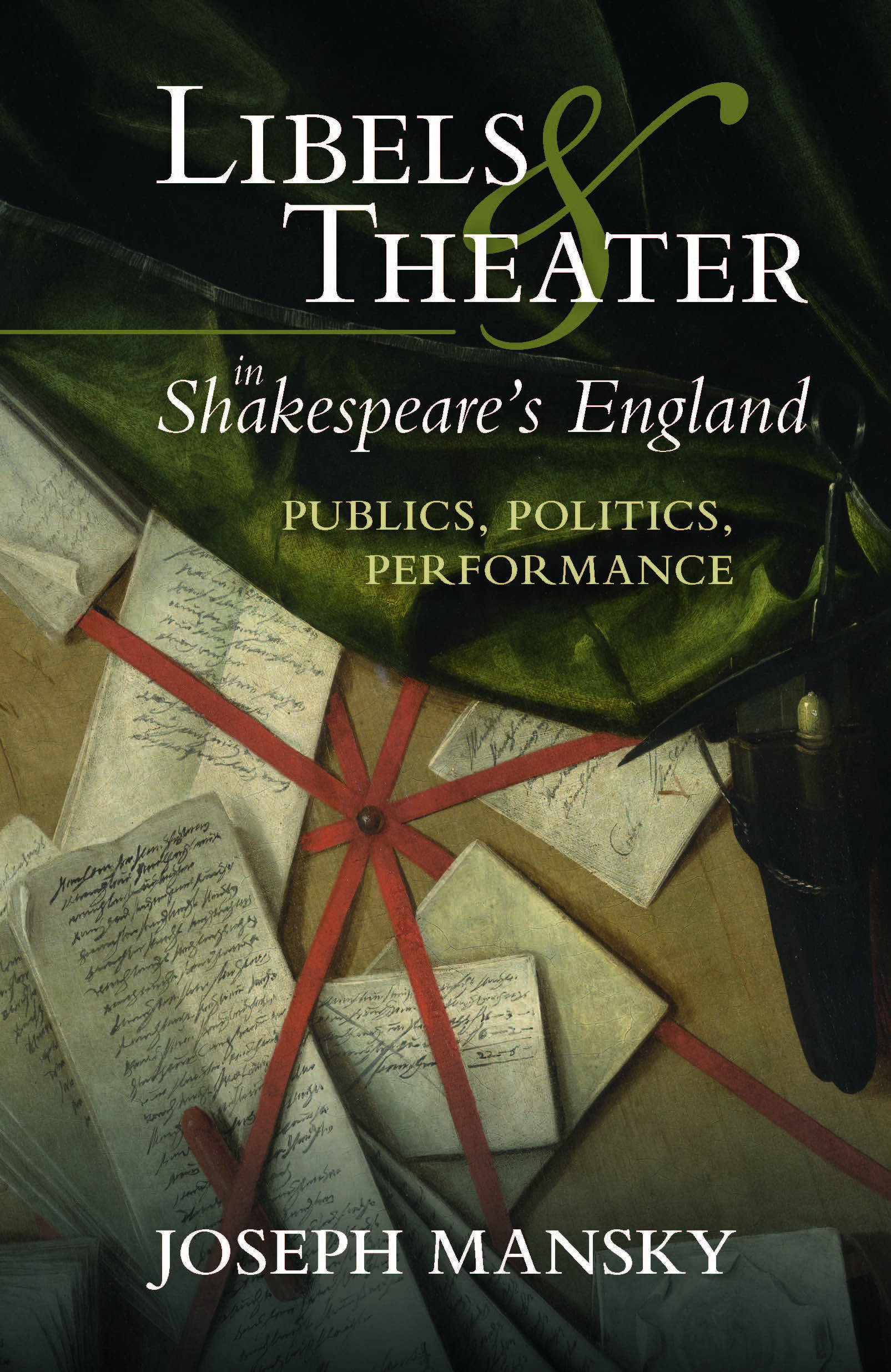
Libels and Theater in Shakespeare’s England: Publics, Politics, Performance
In the 1590s, a series of crises—simmering xenophobia, years of dearth and hunger, surges of religious persecution, the fall of the Earl of Essex—sparked an unprecedented explosion of libeling. The same years also saw the first appearances of libels on the London stage. This book offers the first comprehensive history of the Elizabethan libel and its intimate relationship to theatrical performance. Avatars of sedition, libels nonetheless carved out spaces for ordinary people to pass judgment on the most controversial issues and persons of the day. Ranging from Shakespearean drama to provincial pageantry, the book reassesses the politics of the early modern theater and illuminates the viral (and often virulent) media ecosystem that sprung up around it.
Political Representation: A Literary History, 1580–1651
Representation is the bedrock of modern democratic politics, yet the relationship between representation and democracy has always been an “uneasy alliance,” as the political theorist Hanna Pitkin once put it. This book is a literary-historical inquiry into the nature and origins of this problem. To reconstitute early modern ideas of representation, it examines claims to speak for the people across a variety of literary, legal, and political sources. Literature is an especially valuable archive because poets and politicians shared a repertoire of rhetorical techniques for representing things or people, whether in parliament or in a play. Tracking those techniques from Tudor humanism to the English Revolution, the book tells a new history of the perennial tensions between representation and popular power.
Articles & Chapters
Shakespeare, Populism, and the Public Sphere
Routledge Companion to Shakespeare and Politics
2023Alchemist, Scholar, Spy: The Career of Henry Wright
Huntington Library Quarterly
2022Rethinking Royalism in Herrick’s Hesperides
Review of English Studies
2021Edward Coke, William West, and the Law of Libel
Journal of Legal History
2021The Case of Eleazar Edgar: Leicester’s Commonwealth and the Book Trade in 1604
Papers of the Bibliographical Society of America
2019“Variety” and Republican Violence in Sidney’s Arcadia
ELH
2019“Look No More”: Jonson’s Catiline and the Politics of Enargeia
PMLA
2018Jane Shore, Edward IV, and the Politics of Publicity
Renaissance Drama
2016“Unlawfully published”: Libels and the Public Sphere in Titus Andronicus
Shakespeare Quarterly
2015Does Relation Stand? Textual and Social Relations in Paradise Regain’d
Milton Studies